
The enquiry lands at 11:40 PM. Your reply goes out at 11:10 the next morning.
By then the applicant has already filled somebody else's form.
Admission communication fails on timing far more often than on content. The answers exist, in the prospectus and in three people's heads, but they do not reach the applicant in the minute they were asked for.
Fixing that is now mostly a configuration exercise, not a hiring one.
The three jobs of admission communication
Most institutes treat communication as one problem. It is three, and each needs a different mechanism.
| Job | What it looks like | How it should run |
|---|---|---|
| Transactional | Application received, payment confirmed, hall ticket issued | Automatic, triggered by the event, never typed by hand |
| Conversational | "Am I eligible?", "What is the SC category fee?", "Is the date extended?" | Answered instantly, in the applicant's language, on their preferred channel |
| Campaign | Deadline extension, document clarification, exam date announcement | Bulk send to a filtered set, logged for audit |
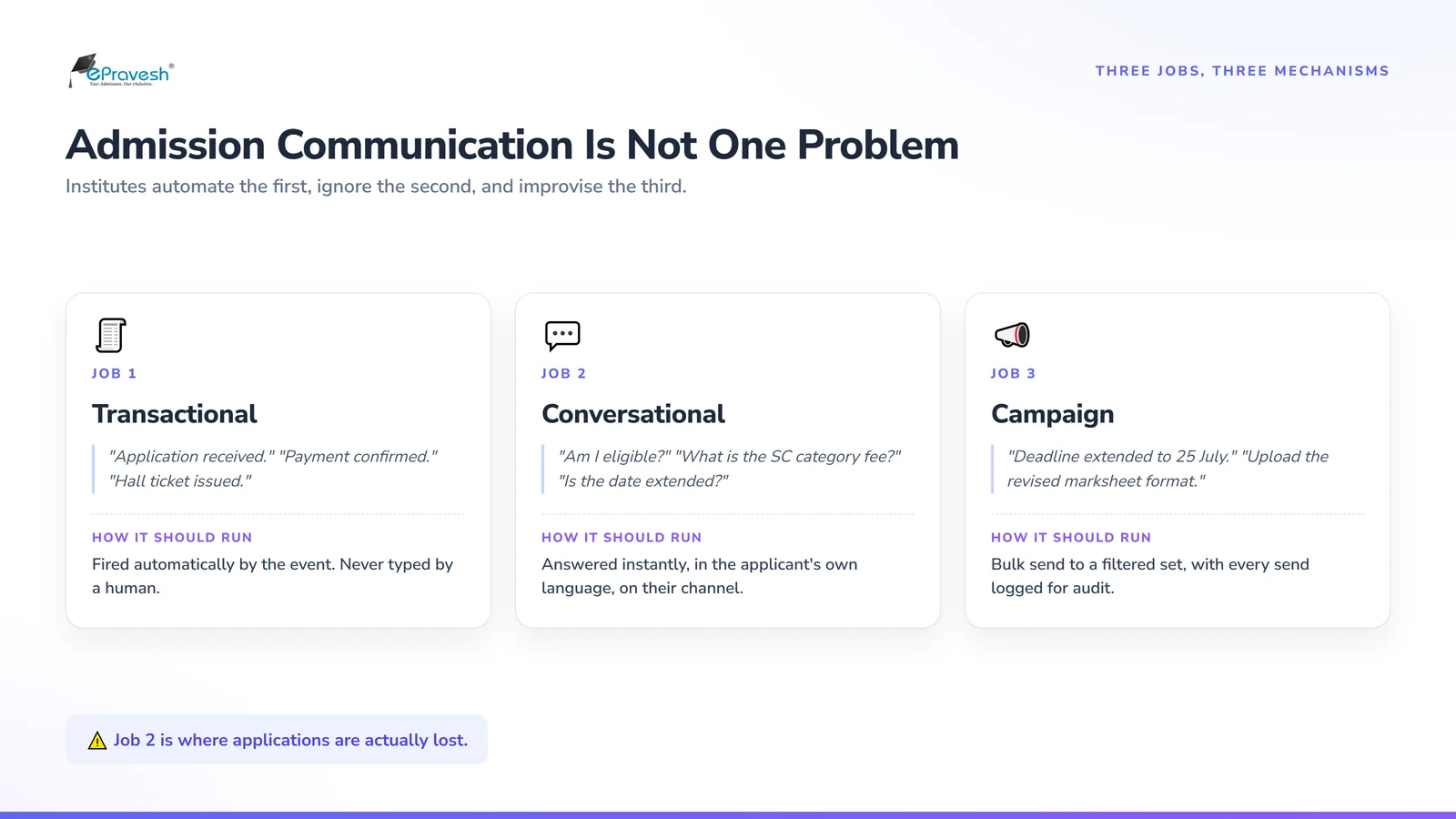
Institutes usually automate the first, ignore the second, and improvise the third. The second is where applications are actually lost.
Why WhatsApp carries the conversation
Applicants read WhatsApp within minutes and email within days. That single behavioural fact decides where your counseling capacity should sit.
A WhatsApp admission agent runs on your own verified business number, one number per institute, so inbound messages route only to your admission engine.
The agent answers from your live course data and your uploaded knowledge base. Eligibility, fee slabs and deadlines come from the system of record, not from a script somebody wrote in June.
It mirrors the applicant's language automatically. A question typed in Marathi gets a Marathi answer, with no separate configuration per language.
❌ Human front desk alone
- Hundreds of repeat questions every day in peak week
- Night and weekend enquiries answered the next working morning
- Counselors retype the same eligibility answer a thousand times
- Half-filled applications drop off unchased
✅ WhatsApp counselor plus staff
- Routine questions answered instantly from your course data
- Applicants guided from first message to a paid seat
- Staff time reserved for cases that genuinely need judgement
- Every conversation visible to admins in one inbox
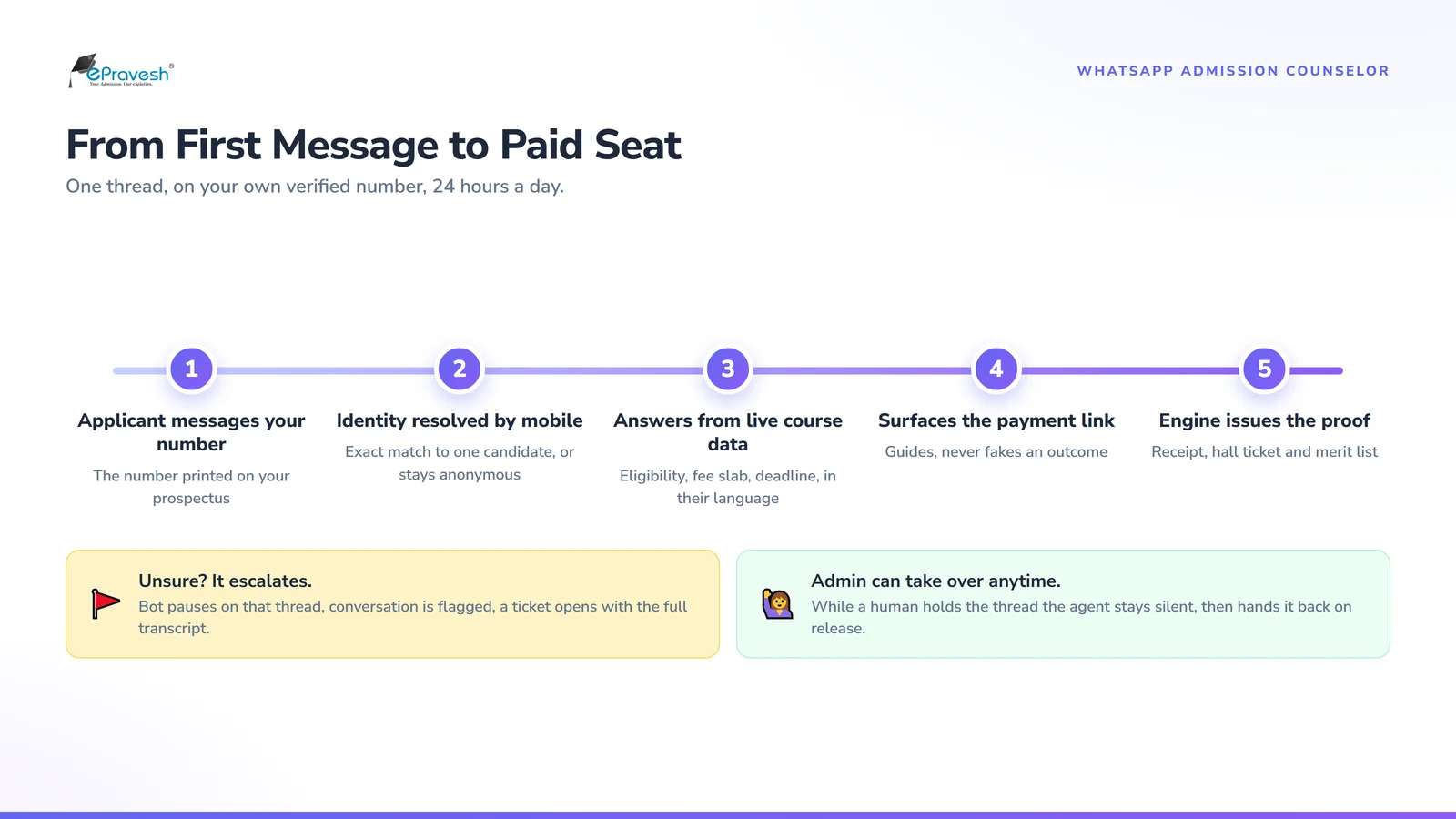
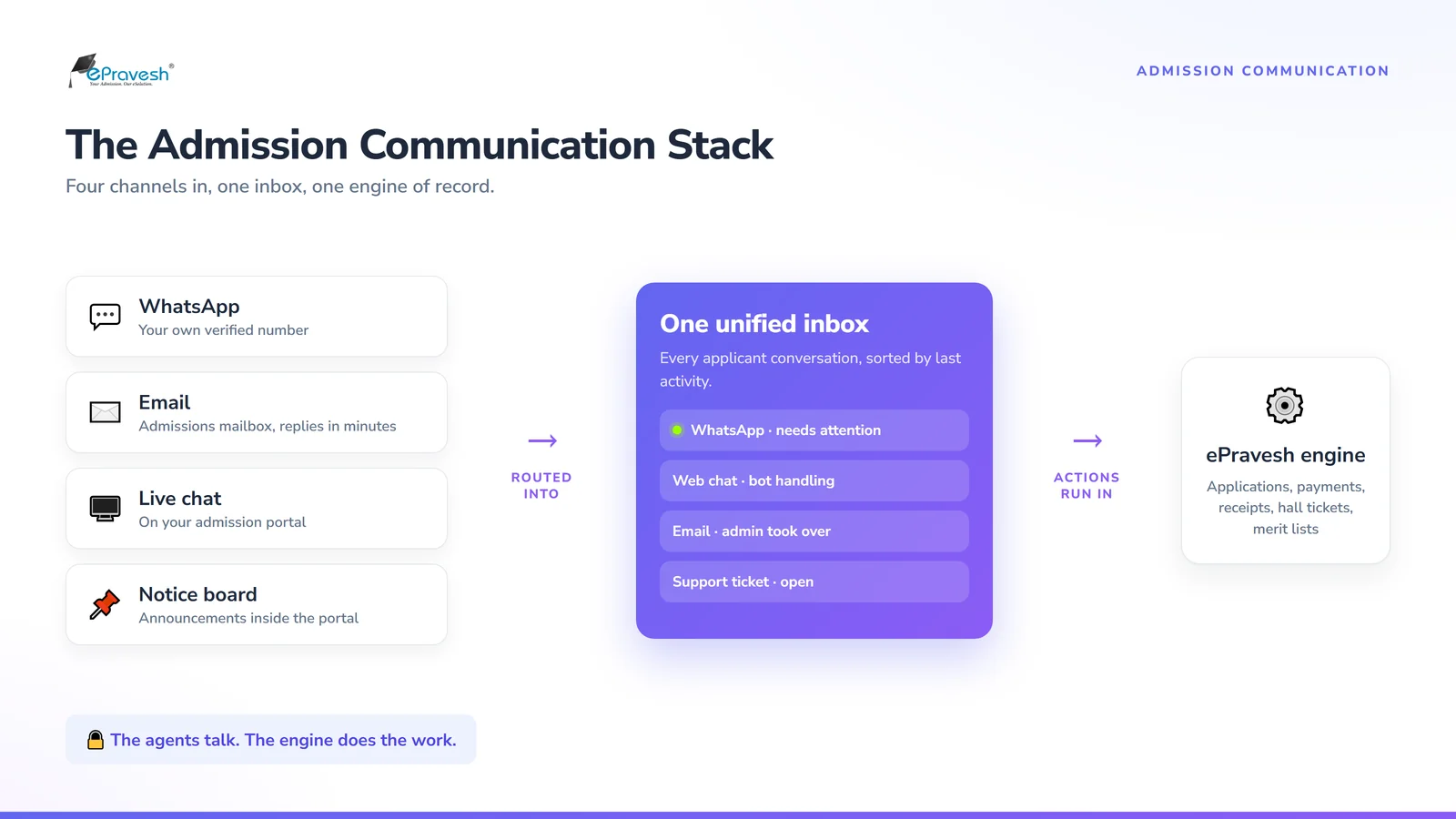
The design principle behind it is deliberately narrow: the agents talk, the engine does the work.
The agent explains the fee and surfaces the payment link. The payment, receipt, hall ticket and merit list are all produced by the native ePravesh engine. An agent never invents an outcome it cannot prove.
Email is slower, and still indispensable
Email is where the admission record lives. Application PDFs, payment receipts, merit list intimation and admission letters need an addressable, forwardable, printable trail, and WhatsApp is a poor substitute for that.
Two distinct things run over email, and it helps to keep them separate.
Automatic transactional mail fires on state changes: application submitted, payment confirmed with a downloadable receipt, verification status, shortlist published, admission confirmed. Each one removes a category of inbound phone call.
The email agent answers applicants who write to your admissions mailbox. You connect one mailbox per institute over IMAP and SMTP, threads appear in the same inbox as your chats, and the agent replies around the clock.
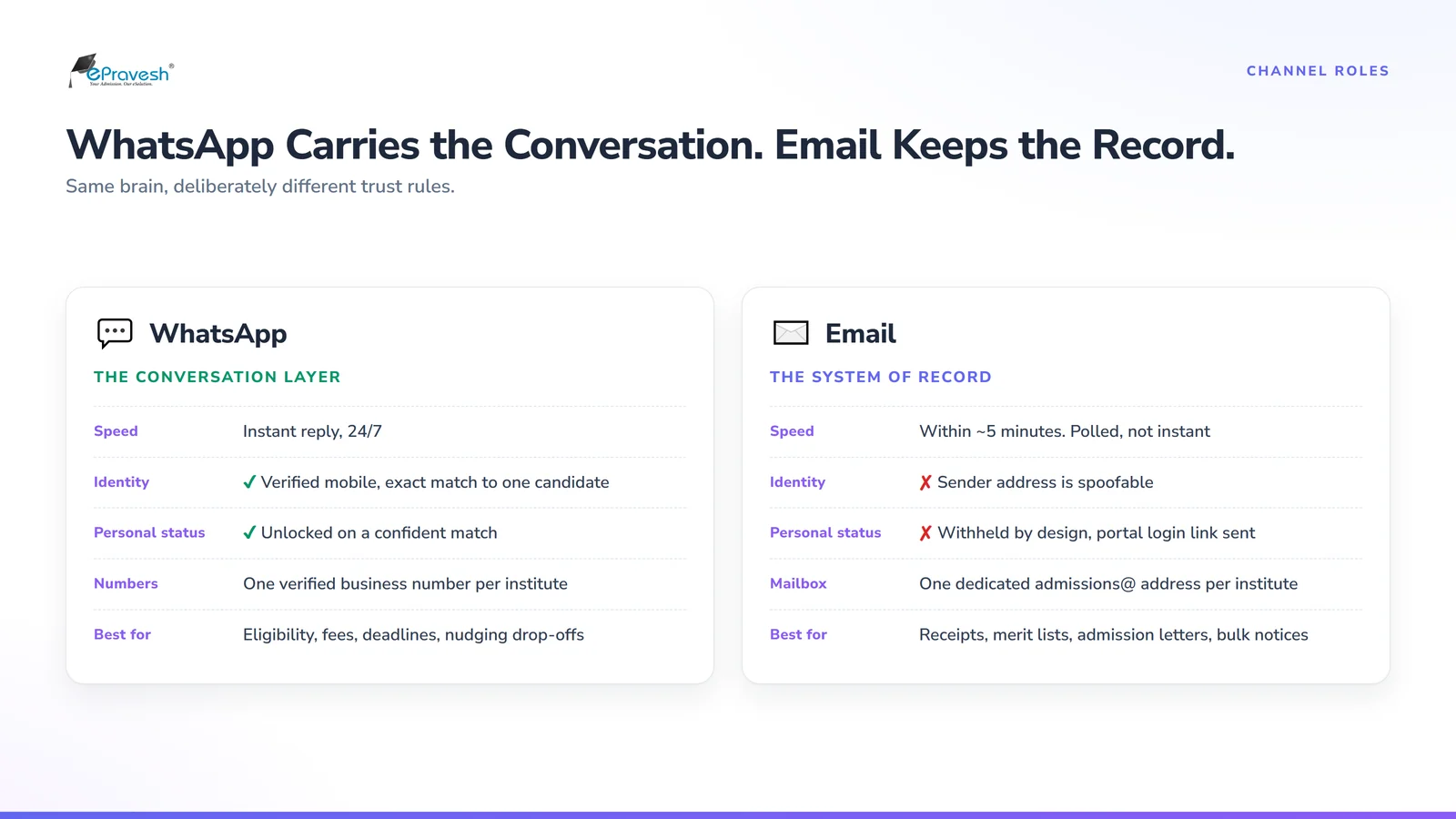
One caveat worth setting internally: inbound mail is polled, not pushed. Applicants see a reply in roughly five minutes, not instantly. Say "within minutes" on public pages, never "instant".
Email also gets a stricter trust rule than WhatsApp. A From: header is spoofable, so the email agent treats every sender as anonymous and refuses to read out personal application status.
Applicants asking "has my payment gone through" receive a portal login link instead of an answer. That is a deliberate refusal, not a gap.
For announcements, the admin panel's bulk email engine sends to a course's applicants or a filtered subset, such as unpaid applicants only, with every send logged for audit. Pair it with the notice board so the same information sits in the portal and not only in inboxes.
One inbox behind every channel
Three channels create three screens, and three screens create missed messages. They should collapse into one.
A unified inbox merges web live chat, WhatsApp threads and support tickets into a single list, sorted by last activity, with a needs-attention flag and filters by channel and status.
Every thread supports the same two actions.
Take over pauses the bot on that conversation and hands it to a named admin. While a human holds the thread, the agent stays silent, on both WhatsApp and web chat, and the applicant's messages route straight to the person.
Release hands it back once the exception is resolved.
That takeover model is what makes automation safe to switch on. You are not choosing between a bot and a counselor. You are choosing which conversations reach the counselor.
What should still be human
Escalation should be a designed path, not a failure state. When the agent is unsure it does four things in order: stops answering, flags the conversation for attention, pauses itself on that thread, and opens a support ticket carrying the full transcript.
Your counselor then picks up a conversation with context already attached. No "can you repeat your query", no re-asking for the application number.
Keep these human by default:
- Fee waivers, concessions and any discretionary decision
- Disputed document rejections
- Anything a parent escalates by phone
- Complaints that could become a grievance
candidate.registered, application.submitted and payment.confirmed to any endpoint you register, in near real time, so your CRM or notification platform reacts the moment the event happens. See integrations.Guardrails to set before you switch it on
- Start ingest only. Let inbound email and WhatsApp land in the inbox with humans replying, for one week, before arming the bot. You will read exactly what applicants ask and fix your knowledge base first.
- Respect the messaging window. Reactive replies to an inbound message are always allowed. Proactive nudges such as deadline reminders need approved message templates, so plan those separately rather than assuming they work on day one.
- Use a dedicated address. Point the email agent at
admissions@yourinstitute.edu, never the principal's general inbox. - Check the transcript policy. Stored conversations redact emails, phone numbers and identity numbers, while structured contact details are captured on the ticket instead.
- Publish a support number. An automated stack still needs a visible human escape hatch, and it belongs in the candidate header.
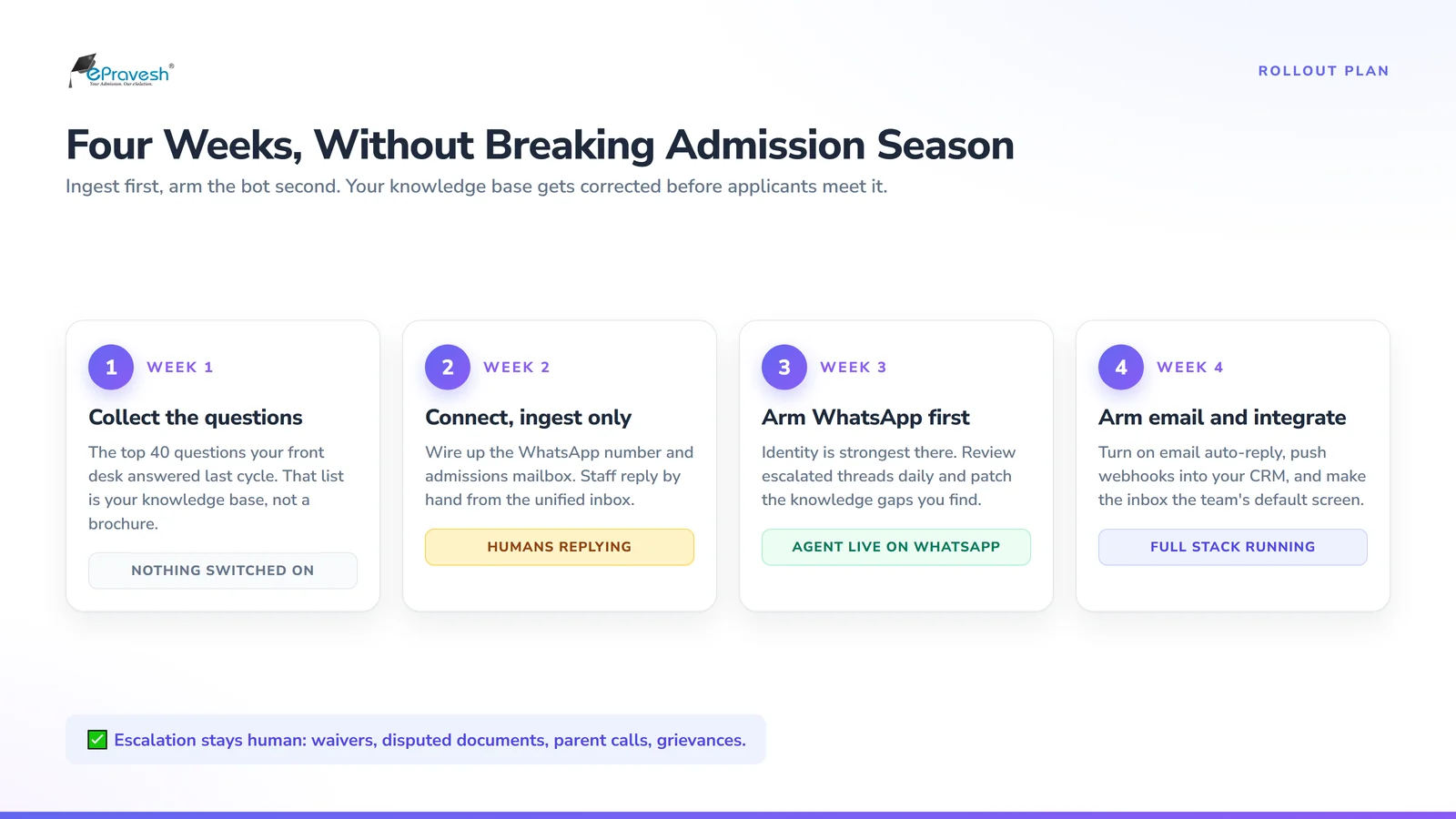
A four-week rollout that survives admission season
- Week 1: Collect the top 40 questions your front desk answered last cycle. That list is your knowledge base, not a marketing brochure.
- Week 2: Connect the WhatsApp number and the admissions mailbox in ingest-only mode. Staff reply manually from the unified inbox.
- Week 3: Arm the agent on WhatsApp first, because identity there is strongest. Review escalated threads daily and patch knowledge gaps.
- Week 4: Arm email auto-reply, wire webhooks into your CRM, and hand the inbox to the admission team as their default working screen.
Key takeaways
- Transactional, conversational and campaign messages are three different jobs needing three different mechanisms.
- WhatsApp is where applicant conversations belong, on your own verified number, grounded in live course data.
- Email stays the system of record for receipts, merit lists and admission letters, and replies in minutes rather than instantly.
- Personal status is unlocked by verified mobile identity on WhatsApp and deliberately withheld over email.
- Every channel should collapse into one inbox with human takeover, because that is what makes automation safe.
- Roll out ingest-first, then arm the bot, so your knowledge base is corrected before applicants meet it.
- The three follow-ups that recover applications, covered in our communication strategy guide, still apply on every channel.
The institutes that convert best in a crowded admission season are rarely the ones with the biggest counseling team. They are the ones whose applicants never wait overnight for an answer.
See how the AI counseling suite sits on top of the admission engine, or book a free demo to connect it to your own courses and knowledge base.
Frequently Asked Questions
Can we use our own institute WhatsApp number for admission queries?
Yes. Each institute connects one verified WhatsApp business number, and inbound messages route to that institute only. Applicants message the number printed on your prospectus, not a shared bot number.
Will an AI agent share an applicant's fee or payment status over WhatsApp?
Only when the sender's WhatsApp number matches exactly one candidate mobile on record for that institute. If the number is ambiguous or unmatched, the agent stays anonymous and shares only public course information.
How fast does the email agent reply?
Inbound mail is polled rather than pushed, so an applicant sees a reply within roughly five minutes. It is not instant, and you should not promise instant on any applicant-facing page.
What happens when the agent cannot answer a question?
It escalates. The conversation is flagged for attention, the bot pauses on that thread, and a support ticket opens with the full transcript so a counselor can reply with context instead of starting cold.
Do we still need transactional emails if WhatsApp is answering queries?
Yes. Email remains the system of record for application PDFs, payment receipts, merit list intimation and admission letters. WhatsApp handles the conversation; email carries the document trail.