
Collect the right fee, on time, every time.
Base fee, slabs, category overrides and coupons resolve in one strict order — and every application keeps a fee-breakdown snapshot.









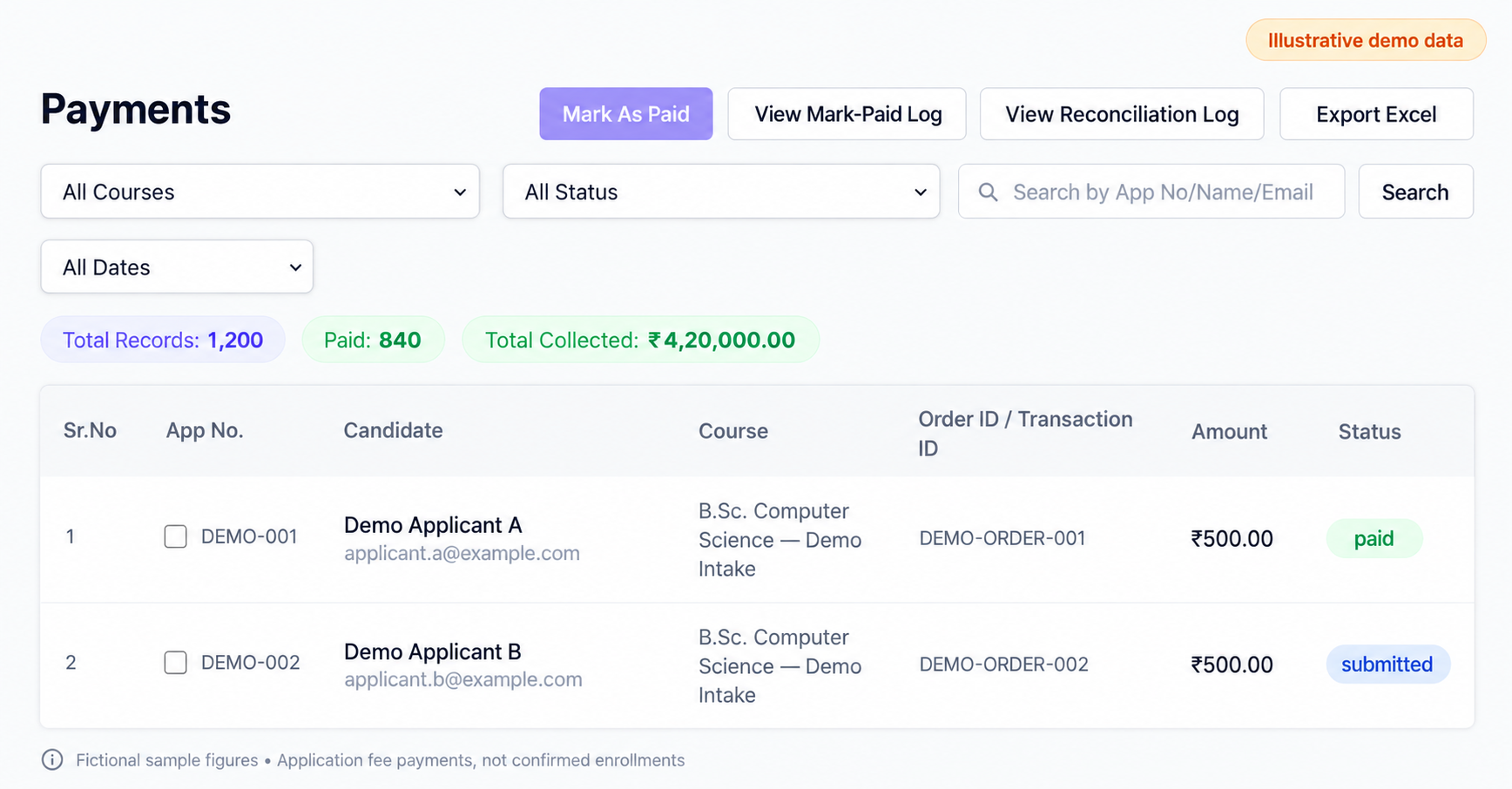
Track application-fee collections
See payment status and collection totals in the payments console.
The right discount always wins — automatically.
The payable resolves in layers — predictable, auditable, no guesswork about which discount applied.
Give the course a flat amount, a category-wise amount, or make it free.
Your teamDefine early-bird, regular and late-fee date windows as a fixed amount or a percentage.
Your teamThe applicant enters a code and it is validated at payment, within its rules.
ApplicantThe final payable is computed and the fee breakdown is stored on the application.
ePravesh engineThe snapshot keeps receipts honest
- Each application stores its own fee-breakdown snapshot at the moment of payment.
- Change a slab, coupon or category fee later — past receipts do not shift.
- Every line (base, slab, category, coupon) stays reconcilable months later.
Fee types you can set per course
- Fixed flat — one amount for everyone.
- Category-wise — a different fee per reservation category.
- Free — no fee; the application completes without a gateway.
Charge early birds less, latecomers more — hands-free.
Slabs move the price by date; coupons give you targeted, audited discounts. Both configurable per institute, on only when you need them.
Date-range pricing
Early-bird, regular and late-fee windows as fixed amount or percentage, with category overrides inside a slab and an active/inactive toggle.Configurable
₹0 skips the gateway
When payable resolves to ₹0, the gateway is skipped and the application completes instantly as paid — no dead-end checkout.
Common & unique codes
Common coupons: reusable, one redemption per candidate. Unique coupons: single-use globally. Fixed or percentage, with validity window and max-use limit.Configurable
Up to 1,000 codes
Generate up to 1,000 codes with a custom prefix for campaigns and partner drives — each scoped to your institute.Configurable
Usage log + export
Every redemption is logged with an exportable audit trail — finance reconciles who used which code and when.
Per-institute isolation
Coupons, slabs and fee config are scoped per institute — nothing leaks across tenants.
Add the WhatsApp, voice, chat and email agents — applicants who stall at "which fee applies to me?" get answered on the spot, then nudged back to a completed payment. See the Suite →
Fee slabs and discount coupons are configurable per institute (fee_slab_enabled, discount_coupon_enabled) — not every institute runs them. AI counseling agents are an optional add-on.
What finance teams ask about admission fees.
Can we charge a different application fee per category?
Yes. A course's base fee can be a fixed flat amount, a category-wise amount that differs per reservation category, or free. Category overrides also work inside a fee slab, so an OBC early-bird applicant and an OPEN late applicant each resolve to their own correct payable without anyone doing the maths.
How do early-bird and late fees work?
You define date windows — early-bird, regular and late-fee — as either a fixed amount or a percentage, and the slab that matches the application date applies automatically. Each slab has an active/inactive toggle and can carry its own category overrides. Fee slabs are configurable per institute, so you run them only in cycles that need date-based pricing.
Which discount wins if a slab, a category fee and a coupon all apply?
All of them, in a strict order — base fee, then slab, then category override, then coupon — resolving to one payable. Because the order is fixed rather than "best discount wins", the result is predictable and auditable, and every line stays reconcilable months later when finance asks why a candidate paid ₹765 instead of ₹1,200.
What is the fee-breakdown snapshot?
It is a copy of the exact fee lines stored on the application at the moment of payment. Change a slab, retire a coupon or revise a category fee later and past receipts do not shift, because each application carries its own frozen breakdown. That is what keeps receipts honest across a long admission cycle.
Can we issue discount coupons for a campaign?
Yes, as common codes (reusable, one redemption per candidate) or unique codes (single-use globally), each fixed or percentage with a validity window and a max-use limit. You can bulk-generate up to 1,000 codes with a custom prefix for partner drives, and every redemption is logged with an exportable audit trail. Coupons are configurable per institute.
What happens when the payable comes to zero?
The gateway is skipped entirely and the application completes instantly as paid. A full-value coupon or a free course does not dead-end the candidate at a ₹0 checkout screen — the zero-fee fast-path closes the application out and moves them to the next step.
Price your admissions exactly the way your finance team needs.
Book a demo — we'll model your fee structure live: slabs, category fees, coupons, snapshots.